


So you’ve decided you want to learn the flute. You’ve acquired a good instrument and have chosen how you want to learn. You’re eager to get going. In this blog post, I take you through your first four flute lessons. I recommend spending about a week on each lesson. Ready? Let’s begin.
Your approach to learning the flute as an adult beginner
First things first. Let’s talk about mindset. When learning the flute as an adult beginner, how you approach your flute journey is absolutely vital. As adults, our minds tend to get in the way. Before you begin, I encourage you to lay aside all expectations and preconceived ideas of learning the flute, as well as any judgment. The best approach to adopt is one of playfulness and curiosity. Even though this may be difficult at first, remaining open, non-judgmental, and curious throughout your journey will take you far!
Lesson 1: Creating your first sound
To create your first sound, all you’ll need is your flute’s headjoint. Practicing with just your headjoint is an important first step in finding your natural embouchure (the way you apply your mouth to the mouthpiece). It may seem a little silly, but it’s a very important first step, and I encourage you not to skip it. Practicing in this way helps your muscles figure things out and find a comfortable position for your mouth to rest on the flute. And yes, you may sound terrible for a while, but give it time. If you keep at it, you will start seeing an improvement!
To help you know exactly what to do, I’m sharing the very first video in our Smart Start learning program for beginners down below:
Usually, during the first or second lesson, I will also help students understand what breathing is all about. Surprisingly, it is not that we have to learn how to breathe. Rather, we have to unlearn how we think we need to breathe. So, as you get started creating your first sound, why not take a moment to explore the breath with this blog post?
Lesson 2: Tonguing on the flute
Once you’ve laid the foundation of producing a basic tone on the flute, you’ll move on to another important skill: tonguing. Tonguing refers to the way notes are enunciated on the flute. Individual notes are formed by tonguing. We’ll continue to develop your tone while learning to tongue on the flute.
When it comes to tonguing, here are some important points to take note of:
🎶In general, the start of a note is not just created with moving air but with the tongue creating a ‘tu’ sound. Try whispering the word ‘two’ with a great amount of air to get a feeling for this.
🎶The tongue does not create the sound; however, it adds definition to the start of it.
🎶The tongue is ideally hitting the inside of the mouth, on the hard palate just behind the front teeth.
🎶Every time you breathe, you will use the tongue to start the next note after the breath. The only time you will not use the tongue is when you have a slur. We will get to that!
Watch the video on how to tongue on the flute below:
Lesson 3: How to hold your flute
Now that you’ve established your tone and understand some of the basics of breathing and tonguing, we can start putting your flute together. It’s so important not to rush this stage; I cannot emphasize this enough. Take your time developing your tone on the head joint only. Even when you start putting it all together, go back to your head joint each day to solidify that tone.
To set up your flute, make sure the tone hole on the head joint is more or less lined up with the first key of the flute (for now, we may adjust this slightly down the line). The rod of the foot joint should be in the middle of the lowest key on the body of the instrument.

In the next video lesson, I am going to teach you how to hold the flute. Take your time with this!
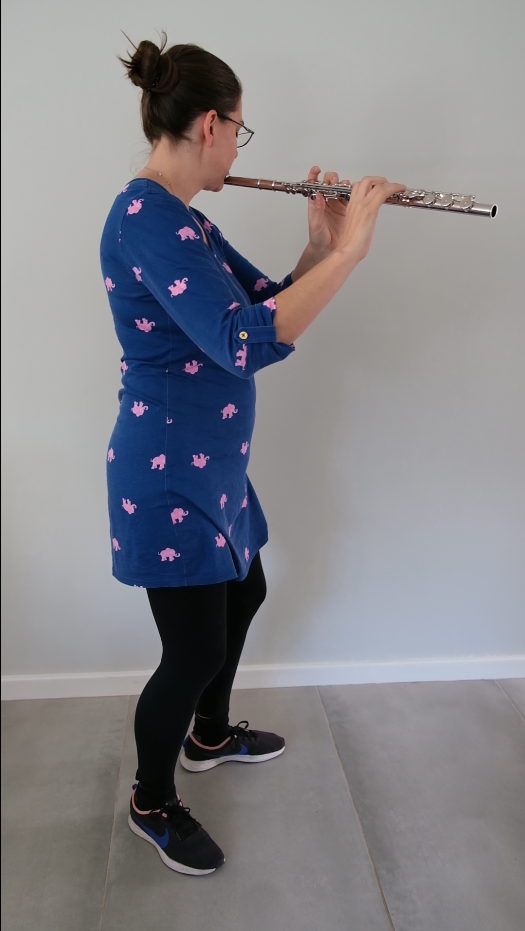
It’s also important to stand properly.
This means aligning your feet, knees, hips, spine, shoulder and head. Then allow your head to pivot gently over to the left and bring up your flute so that it is at an approximately 30-45 degree angle to your shoulders. If you need some more help with this, check out this video.


Lesson 4: Learning your first notes
It’s finally time to start learning your first notes! I usually start with the notes B, A and G. These are the easiest to get a clear sound and give you a chance to get used to holding your flute.
Watch the video below to learn how to play your first notes.
And – good news! We also have an extra treat for you – it’s the first resource from our Smart Start Beginner Program, designed for adult beginners just like you. Click here to get access to it and start learning. And if you’re thinking – but I can’t read sheet music! – don’t worry, we’ve got you covered. Head on over to this blog post, which covers the basics. And if you’re interested in a more in-depth course, our Smart Start program has a full crash course for learning sheet music integrated into the program. So if you are learning from scratch, don’t let this stop you!
Some last words…
Dear beginner flutist, I hope you’ve enjoyed diving into these first four flute lessons with me. They are but the start of a wonderful, fulfilling musical journey. And if you’ve come this far already, you’re off to an amazing start! Learning the flute as a beginner can be daunting, but when you take things step by step and have the right guidance and support, you’ll go far. We’ve got so many success stories of students in our community proving this very point. And if they can do it, so can you!
If you’ve come this far and want to continue, I highly recommend our Smart Start beginner program. It will give you all the tools, resources, and support you need as a beginner. Learn more about it here.
Happy practicing!
Stop wondering what to practice.
Start with confidence from day one.
Smart Start gives you a clear, day-by-day plan so you always know exactly what to do when you sit down to practice. In just 12 weeks, go from your very first sound to playing melodies people recognize.


this is so true! for beginner, especially if they have to stick online, it is very helpful to have different camera angles to cover then fundamentals.
First 50 days flautist. Short video of Ode to Joy, Greensleeves, Paint it Black. Event on the 29th, Morley College London UK . FREE! I will be there with bells and my flute. Not good with posting. https://www.eventbrite.co.uk/e/morley-jam-session-tickets-1989915887988
l cannot see how to post a video of playing the flute here. Where is download attach??? Morley College gonna be great. They have an Adult learning orchestra. I hope to join in about a year. You have to be playing for at least 2 years. I played Clarinet, 8 years, Oboe soloist, 2 years, and Alto Saxophone 1 year at University.